
Regaleira Symbolism & Secret History Explained 2026
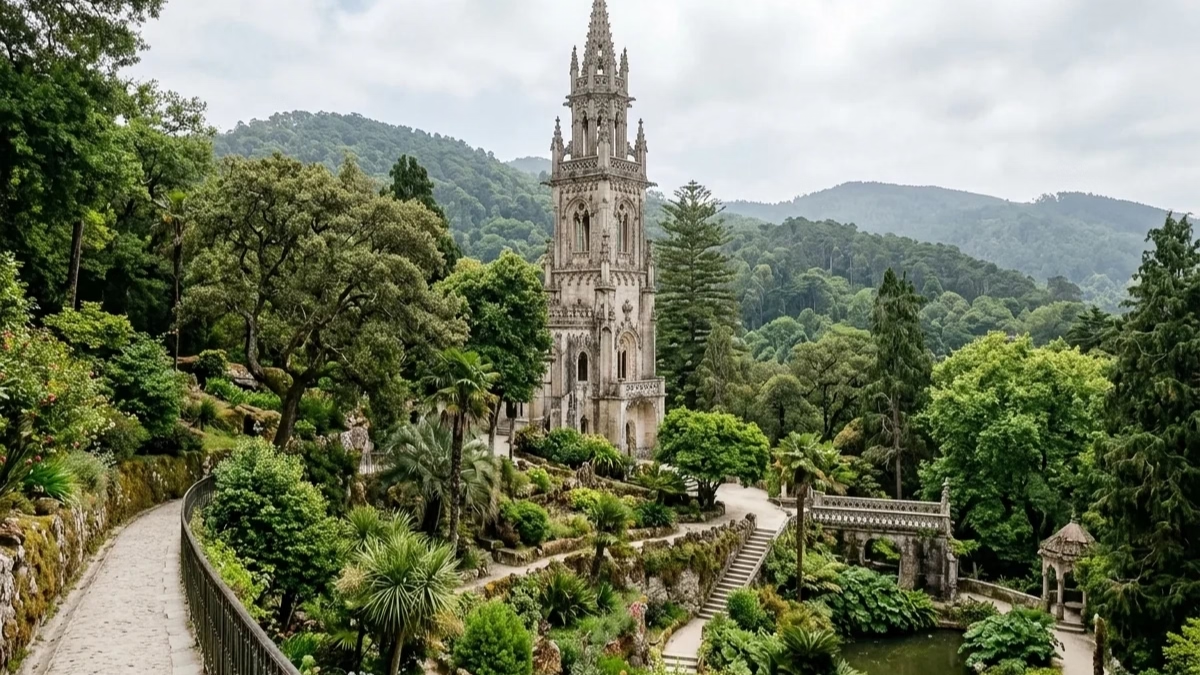
Quinta da Regaleira was conceived by Carvalho Monteiro as a coded landscape encoding his fascination with the Knights Templar, Freemasonry, Rosicrucianism and alchemy. The estate is widely read as an initiatory journey — a symbolic passage from darkness to light through the wells and tunnels, echoing Dante and alchemical transformation. How much was intended and how much is later legend is part of its enduring appeal.
Quinta da Regaleira is often called a “magic palace” or an esoteric puzzle, and the reputation is earned. António Augusto Carvalho Monteiro, one of the richest men in Portugal, spent a fortune building an estate that works as a landscape of ideas as much as a garden.
This guide steps back from individual carvings to look at the bigger picture: the vision behind the estate, the initiatory “journey” it stages, the traditions it draws on, and — importantly — where solid history ends and legend begins. For the concrete motifs to look for on the ground, see our companion Freemasonry and Templar symbols spotter’s guide.
Carvalho Monteiro’s Esoteric Vision
Carvalho Monteiro, nicknamed “Monteiro dos Milhões” for his wealth, commissioned the estate between 1904 and 1910 with the Italian architect Luigi Manini. A scholar with deep interests in mysticism, the Templars, Freemasonry and alchemy, he designed Regaleira as a personal statement — a garden that encodes his philosophy rather than simply displaying his fortune.
Carvalho Monteiro was a collector, a scholar and a Portuguese patriot who idealized the age of discoveries and the legacy of the Templars. Rather than build a conventional showpiece estate, he worked with Manini — a set designer as much as an architect — to create something closer to a stage: a landscape you move through, where meaning is built into the sequence of spaces. That theatrical instinct is why Regaleira feels less like a garden and more like an experience with a beginning, a middle and an end.
The result is an estate where the palace, chapel and gardens all speak the same symbolic language. Monteiro left no single manifesto explaining his intentions, which is precisely why the estate has generated a century of interpretation. What’s clear is that he built it as an argument in stone, not just a home.
The Initiatory Journey: Darkness to Light
The estate is widely read as staging an initiatory journey. You descend the Initiation Well through nine landings into darkness, pass through the underground tunnels, and emerge into the light of the gardens beside the lakes — a symbolic passage of death and rebirth, or ignorance to enlightenment, that mirrors initiation rites in Masonic and esoteric traditions.
The most compelling reading of Regaleira is choreographic. The Initiation Well is not a well at all — no water was drawn from it. It’s an inverted tower you descend, spiraling down through nine levels into the earth, and it can only be walked in one direction: down. From the bottom, you pass through dark, winding tunnels and emerge, often unexpectedly, into daylight beside a lake or grotto.
That sequence — descent, passage through darkness, emergence into light — maps directly onto the language of initiation: a symbolic death and rebirth. Whether you take it literally or simply as a beautifully staged walk, the estate is clearly designed to be experienced as a journey with meaning, not a set of separate sights. It’s the single idea that ties the whole place together.
Dante, the Templars and Alchemy
Three interpretive threads run through most readings of the estate. The Dante thread points to the Initiation Well’s nine levels as an echo of the nine circles of the Inferno, with the descent and eventual ascent tracing the arc of the Divine Comedy from hell toward paradise. The Templar thread runs through Monteiro’s admiration for the Knights Templar and their Portuguese successors, the Order of Christ, whose cross marks the well’s floor.
The alchemical thread is subtler and arguably the most pervasive: the whole estate reads as a transformation, base matter turned to gold, darkness turned to light, the crude self refined through trial. These readings aren’t mutually exclusive — Monteiro drew on all of them, and the estate rewards holding several in mind at once. Each tradition surfaces in the physical detail of the carvings, floors and thresholds you pass along the way.
Documented Fact vs Legend
Some things are well documented: the dates (1904–1910), the architect (Luigi Manini), Monteiro’s wealth and his interest in the Templars, Freemasonry and alchemy, and the estate’s obvious esoteric vocabulary. Much else — the precise meaning of the “journey,” claims of secret rituals, and whether Monteiro was a formal initiate — is interpretation and legend, since he left no key explaining his design.
It’s worth being honest about the evidence, because the estate’s mystique invites embroidery. Documented history gives us the who, when and how: a hugely wealthy patron, a theatrical architect, a ten-year build, and a garden saturated with Templar, Masonic and alchemical imagery. That much is solid, and you can read the outline in our guide to the estate’s history.
What isn’t documented is a single authoritative explanation of what it all means. Monteiro never published a key, so the “initiatory journey” and the specific symbolic readings are informed interpretation, not established fact — persuasive, widely accepted, but interpretation nonetheless. Stories of secret ceremonies or occult membership are legend rather than record. That gap is not a flaw; it’s the reason Regaleira has fascinated visitors for over a century, and why two thoughtful people can walk the same paths and read them differently.
How to Experience the Symbolism Yourself
The best way to feel the estate’s design is to walk it in the intended order: reach the Initiation Well early, descend, follow the tunnels, and let yourself emerge into the gardens without rushing. Because the well is the estate’s busiest bottleneck and one-directional, arriving at the 10:00 AM opening lets you experience the descent without a crowd pressing behind you.
Context helps enormously, since none of the meaning is captioned on site. A live guided tour walks you through the readings as you go, while a skip-the-line ticket with an audio guide lets you explore at your own pace with commentary in your ear. Either way, knowing the story in advance turns a pretty garden into a deliberate journey.
Frequently Asked Questions
What is the meaning behind Quinta da Regaleira?
The estate was designed by Carvalho Monteiro as a coded landscape expressing his interest in the Knights Templar, Freemasonry, Rosicrucianism and alchemy. It’s widely read as staging an initiatory journey from darkness to light — descending the Initiation Well, passing through the tunnels, and emerging into the gardens. Monteiro left no single explanation, so the meaning is interpreted rather than officially documented, which is part of its lasting appeal.
Is the Initiation Well really about initiation?
No water was ever drawn from it, and its inverted-tower form, nine landings and one-directional descent all point to symbolic rather than practical use. The name and the design strongly suggest a ritual or initiatory reading — a symbolic descent into the earth and rebirth into light. Whether Monteiro intended a literal ceremony or a philosophical metaphor isn’t documented, but the well was clearly built to mean something.
Was Carvalho Monteiro a Freemason or occultist?
He is widely associated with Masonic and esoteric circles, and his estate is saturated with their symbolism, but the documentary record isn’t conclusive about formal membership or ritual practice. His deep interest in the Templars, the Order of Christ, alchemy and initiatory traditions is beyond doubt. The distance between his evident fascination and the hard evidence is exactly where legend has filled the gaps.
How does the Dante connection work?
Interpreters link the Initiation Well’s nine levels to the nine circles of Dante’s Inferno, reading the descent into the earth and the eventual return to the sunlit gardens as an echo of the Divine Comedy’s journey from hell toward paradise. It’s one of several plausible readings Monteiro seems to have drawn on, alongside Templar and alchemical themes. Like the rest of the symbolism, it’s interpretation rather than a documented instruction.
What’s the difference between the symbolism and the symbols?
The symbols are the concrete motifs you can point at — the Templar cross, the stars, the compass-and-square echoes, the rose. The symbolism is the bigger story they add up to: the initiatory journey, the alchemical transformation, Monteiro’s whole philosophy. This guide covers the story; our Freemasonry and Templar symbols spotter’s guide covers the individual motifs and where to find them on the estate.
How much of the “secret history” is true?
The verifiable history is well established: the patron, the architect, the 1904–1910 build, and the estate’s clear esoteric vocabulary. The “secret history” of hidden rituals, occult societies and precise coded meanings is largely legend and interpretation, because Monteiro left no key. It’s best enjoyed as a rich tradition of readings rather than a set of proven facts — compelling, but not confirmed.
Do I need to understand the symbolism to enjoy the visit?
Not at all — the estate is beautiful and atmospheric on its own terms, and plenty of visitors enjoy it purely as a garden and a folly. But knowing the intended journey and the traditions behind it transforms the experience, turning individual sights into a coherent story. Even a little background makes the descent through the well and the emergence into the gardens far more meaningful.
Where can I learn the symbolism on site?
Nothing is captioned on the estate, so you’ll want either an audio guide or a live guide to make sense of it. A guided tour explains the readings as you walk, and an audio guide lets you go at your own pace with commentary. Reading up beforehand — on the well, the tunnels and the chapel — also lets you spot the design’s logic as you move through it.
